
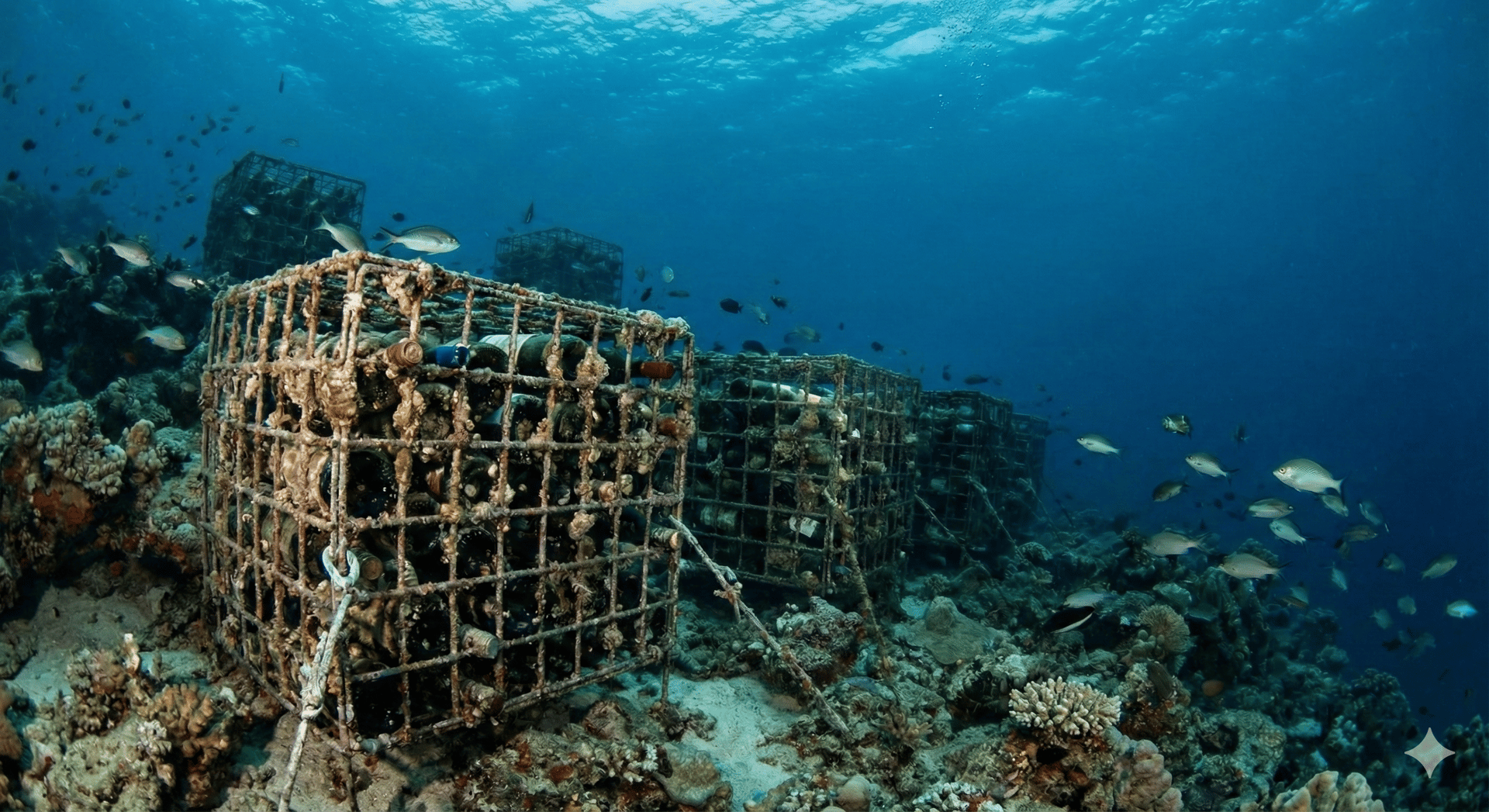
The Blue Cellar
Deep Sea Aging Becomes Mainstream
2/20/20262 min read
The Treasure from the Wreckage
The idea of aging wine under the sea didn't start in a laboratory, but in a shipwreck. In 2010, divers discovered 170-year-old bottles of Champagne in a wreck at the bottom of the Baltic Sea. To their surprise, the wine was not only drinkable but extraordinary, preserved in a state of "suspended animation."
Today, winemakers in France, Spain, Italy, and even Brazil are no longer waiting for shipwrecks. They are intentionally submerging thousands of bottles in specialized cages, creating what the industry now calls "Blue Cellars." This is more than a marketing stunt; it is a fascinating exploration of how hydrostatic pressure and thermal stability affect chemical evolution.
The Physics of the Abyss
Why would a winemaker choose the ocean floor over a sophisticated, high-tech terrestrial cellar? The answer lies in the unique physical conditions found at depths of 30 to 50 meters:
Hydrostatic Pressure: At these depths, the external pressure of the water is significantly higher than at sea level. This pressure differential affects the way gases interact inside the bottle, potentially preventing oxygen ingress and keeping the wine’s primary fruit notes intact for much longer.
Perfect Isothermy: The ocean acts as a giant thermal heat sink. At a certain depth, the temperature remains constant and cool year-round, regardless of heatwaves or seasons. This stability is the "holy grail" of wine storage.
Total Darkness: UV rays are the enemy of wine. Under 30 meters of water, the light is almost completely filtered out, protecting the wine from any light-induced chemical degradation.
The "Constant Stirring" Effect
One of the most intriguing findings from 2026 studies is the impact of kinetic energy. Unlike a still cellar, the ocean is in constant motion. The gentle, rhythmic swaying of the tides and currents creates a continuous "micro-agitation" of the liquid.
For wines aged on their lees (like sparkling wines or certain whites), this motion keeps the yeast cells in suspension, enhancing the autolysis process. The result is a wine with a much creamier texture and a complexity that would take twice as long to achieve on land. It’s as if the ocean is gently "massaging" the wine into maturity.
The Biological "Security Seal"
When the bottles are retrieved after 12 to 24 months under the sea, they are often covered in barnacles, coral, and calcareous algae. Many wineries choose to leave these natural "decorations" on the bottle.
From a collector's perspective, this is a biological guarantee of authenticity. Each bottle becomes a unique piece of art, shaped by the sea. Furthermore, the salt crust that often forms around the cork provides an additional natural barrier against the elements during its final journey to the consumer's table.
Does it Taste Different?
Critics and sommeliers who have performed "blind tastings" comparing the same wine aged on land versus under the sea often report striking differences. The "Sea-Aged" versions tend to show:
Remarkable Freshness: They maintain the acidity and vibrant fruit of a young wine.
Enhanced Complexity: Despite the freshness, they develop the tertiary aromas (like honey, nuts, and minerals) usually found only in much older vintages.
Electric Energy: There is often a described "saline" or "mineral" edge that seems amplified by the marine environment.
The New Frontier
The "Blue Cellar" movement proves that even in an age of AI and digital twins, we are still discovering the secrets of nature. By surrendering their best bottles to the depths of the ocean, winemakers are finding a way to harness the raw power of the planet to create something truly unique. It is a reminder that wine is a liquid that lives, breathes, and reacts to the world around it—even if that world is 40 meters underwater.